Susan Brunskill, SRI Manager, reflects on the power of collaboration in systematic reviews. From early partnerships to award-winning projects, Susan shares how working together with clinicians and researchers worldwide drives evidence-based healthcare and strengthens both knowledge and impact.
When we discovered that the theme for World Health Day this year is ‘Together for health. Stand with science’ we felt like this was a great fit for our team, because we are a systematic review group, and one of the key aspects of systematic reviews is they cannot be done alone. World Health Day on 7th April launches a year‑long campaign “celebrating the power of scientific collaboration to protect the health of people, animals, plants, and the planet.” This World Health Organization campaign will be launched at the One Health Summit and will be the largest scientific network ever convened around a United Nations Agency.
The power of scientific collaboration is a central tenet of the work of the Systematic Review Initiative (SRI). The SRI started in 2002 and in the 23 years since we have collaborated with over 120 different clinicians and researchers from across the UK and world-wide. Many of these have become long-term collaborations with people we joyfully seek to work with again if the topic area allows.
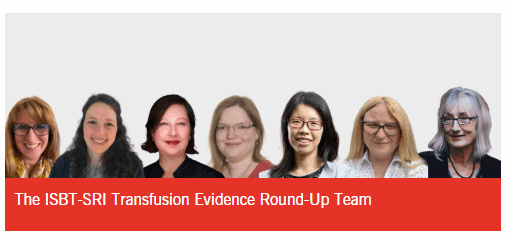
One more permanent collaboration that has grown out of this is a joint project with ISBT (International Society for Blood Transfusion). What started as a brief conversation about sharing resources during Covid has developed into our award-winning quarterly Transfusion Evidence Round-Up and Talking Transfusion podcast [accessible here, on Spotify and Apple Podcasts]. The purpose of both is to provide clinicians and healthcare scientists with easy access to evidence-based publications on all aspects of transfusion medicine, in the belief that this will facilitate the best care for every patient.
Doing a systematic review is always a team exercise. Their power comes in part from the collaboration of experts from more than one field. Systematic reviews seek to be an objective exploration of the evidence base on a specific question. With clinicians and researchers working together to a standard methodology, objectivity is maintained and ensures that no one view dominates. Clinicians bring the clinical subject expertise whilst we, the researchers, bring a range of different research skills: statistics, research methodology, information science and project management to name but a few.
You can find out more about our work and the systematic reviews we have been involved in on this website.
Be sure also to join the global World Health Day conversation, using the hashtags #StandWithScience and #WorldHealthDay.
We are always looking to increase our collaborations – one such area is in developing a Round-Up for our Stem Cell Evidence. This work is in early development with ISBT, so if you have an interest in cellular therapies and want to find out more, please contact us at [email protected]. Additionally, there is space on a review team for all levels of experience, so if you are wondering how you can stand with science this April, please get in touch to see how you can be involved.